
It didn't cost us anything to set-up, but was it effective?
Well, I would have to say that it largely wasn't effective towards my main targeted audience, the students, but I found that newcomers and community patrons could be found in front of the monitor learning about the library from my crude slides, which gave me some satisfaction (that someone was looking at it).
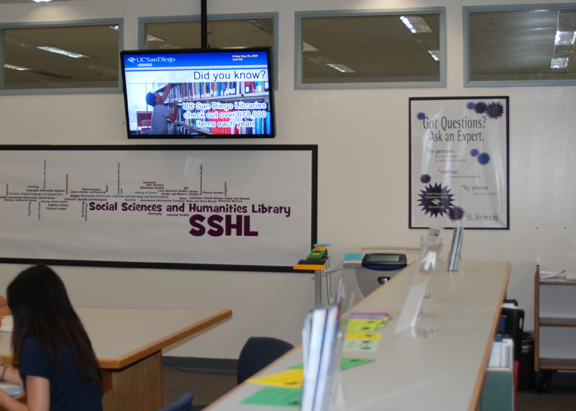 |
| A sign from UCSD's Geisel Library running Carousel. |
Another surprising result of my makeshift digital signage, was the interest from campus services like the Writing Center, who wanted to advertise their events and services on my sign. Also, Faculty had interest in showing slides from a trip abroad, that they wanted students to see and enroll in.
These positive by-products of my digital signage experiment may have had a part in a larger campus wide implementation of digital signage that has been evolving over the summer, then again it could just be coincidence.
A good article for those interested in implementing digital signage in their library is Signs of Success published June 2010 by ACRL. The institution that formed this article (UC Merced) sounds a lot like CSU Monterey Bay, a huge Army base that was closed and turned into a Cal State School during the Clinton years (proud to say I was among the 2nd graduating class of the fledgling CSU).
Signs of Success is a great reference for librarians just getting interested in digital signage and has a checklist of sorts that will aid in deciding what you want out of your digital signage. We (my institution) are not yet at the touch screen or 2 way communication stage of our digital signage, but it is a good thing to consider when looking at digital signage products down the road.
Our institution decided on a product called Author by Enseo, which I have yet to get my hands on really, except for an hour or so of demo and instruction. One notable drawback is the fact that the version we purchased runs only with XP workstations, hopefully there is an update on the horizon. Once I get a box and a connection I will write a review of the product and post here.
Digital Signage Applications for Libraries
Here is a short list of open source digital signage applications that could fit into the needs of academic institutions, government buildings, and libraries. I have not had a chance to give any of these a try, but plan to.
If you have used or implemented one or more of the following I would appreciate a comment or two in the comments section, as I am sure other readers would also benefit from (vendors- please keep the links to a minimum).
Xibo Seems to be one of the more popular Linux based digital signage applications.
Concerto Web based broadcast medium. Site says, "It just works". Sounds easy, but nothing ever is.
Digital Signage Site appears to be abandoned, last update 2004.
Source Forge Follow the link for a long list of digital signage applications for Linux, Mac, and Windows.
Onelan Not open source, but have read about schools using this product.
*Information contained within these pages do not necessarily reflect the opinions or views of Schreiner University.


